 SUNSET:

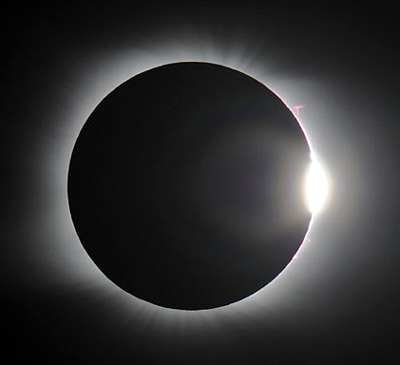
Solar Eclipse Reports and Pix
From near the North Pole down to Siberia and China, thousands of travelers watched the August 1st total eclipse of the Sun. Meanwhile, millions more across Europe and Asia made the most of their partial eclipse.
Eta Carinae Prepares for X-ray Crash
Known for its mysteriousness, one of the galaxy's most massive stars gears up for its periodic pundit-perplexing event. Will Eta Carinae finally reveal its secrets?
Titan Makes a Splash
It's not covered by a global ocean, as theorists once thought. But Saturn's big moon does sport pools of liquid ethane big enough to float anyone's boat.

Tour August's Sky! | July 29th, 2008
Download this month's podcast to take a guided tour of evening sky sights — and learn what the Moon has in common with a Ping-Pong ball! Host: S&T's Kelly Beatty.

NASA Turns 50: Take a Photo!
The U.S. space agency was founded 50 years ago today. You can celebrate by finding your favorite NASA photograph.
An Electrifying Whodunit
Thanks to a quintet of identical spacecraft, space physicists have settled a decades-old debate over what triggers violent electromagnetic substorms inside Earth's magnetosphere.
Earth and Moon Dance for a Far Camera
From more than 30 million miles away, a NASA spacecraft snapped away as the Moon made a graceful pass in front of Earth's colorful disk.
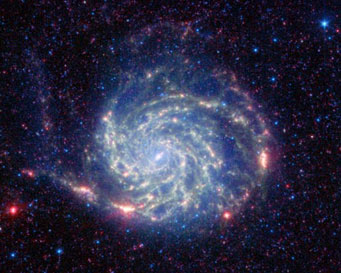
A Galactic Dead Zone
Astronomers find that the organic compounds common throughout our galaxy and others suddenly disappear along M101's outer edge.
Weighing Black Holes with a Thermometer
Astronomers use the 12-million-kelvin-blaze of a galaxy's central region to measure its supermassive black hole.
Mars's Ancient Water Works
New observations from a NASA orbiter reveal that water and rock freely mingled across (or under) much of the Red Planet's surface.
Make Way for Makemake
It took three years to settle on a name for the third-largest object in the Kuiper Belt.
Best in League
The Astronomical League has announced its best webmaster for 2008.
Artificial Intelligence Aids Astronomers
Astronomers have designed a neural network that can determine the particulars of binary star systems by just examining their light curves — and it can do it really, really fast.

August's Partial Lunar Eclipse
On August 16th, the Moon dives deeply into Earth's shadow. This one's for Europe and the Eastern Hemisphere; no one in North America gets to see it. But check out the webcast links!
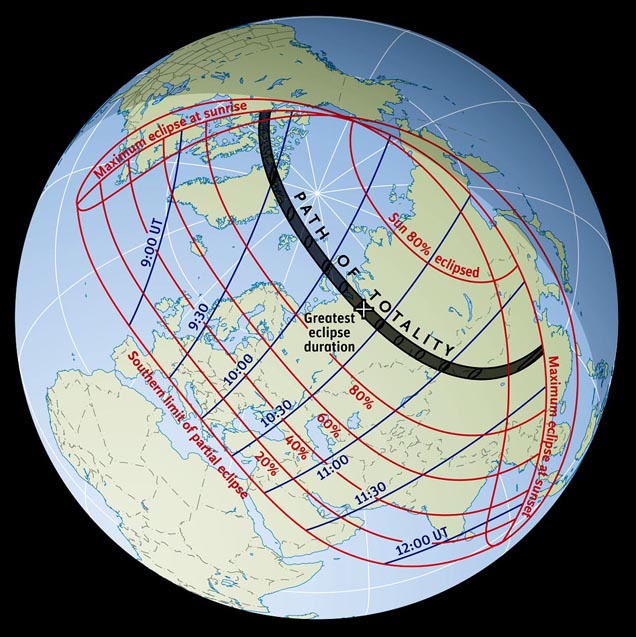
August 1st's Eastern Solar Eclipse
From sunrise on the northeastern fringes of North America, to sunset in China, Korea, and Southeast Asia, the Moon's shadow sweeps across a huge area of the world on August 1st.
All Hail, King Jupiter!
The King of Planets has made a dramatic entrance into the early evening sky. Don't miss your chance to see it while it's big and bright!
Asteroids with Split Personalities
Where did the dozens of known binary asteroids come from? According to a new finding, sunlight alone can force a body to spin in such a frenzy that it literally flies apart.
Jupiter's Third Red Spot May Have Survived
Jupiter's newest red spot was disrupted during its encounter with the Great Red Spot and Oval BA, but appears to be reforming.
Are Jupiters Hard to Come By?
A recent survey of stars in the Orion Nebula Cluster reveals that less than 10% of stars there have enough material in their surrounding disks to form Jupiter-sized planets.
Faint Supernovae Remain Unexplained
A subclass of supernovae that fades much faster than expected reveals possible kinks in astronomers' theories of what causes these explosions.
