 SUNSET:


Ulysses Starts Third Loop of Sun
A 16-year-old spacecraft is once again venturing where no other craft has gone before: over the Sun's polar regions.
DC to Host First "Night Symposium"
An unprecedented assembly of high-level experts will tackle the problem of saving dark skies.
Astronomy & Observing News S&T", "bookmark_label" : "Clicked on Don't Miss Out on the March S&T"}'>
Don't Miss Out on the March S&T
Be sure to visit your newsstand for the March issue of Sky & Telescope. Inside you'll find all the information you'll need for March 3rd's lunar eclipse — the first total eclipse of the Moon since October 27–28, 2004, and much more.

The Best Asteroid Occultation in Decades: A First Report
On the morning of January 26th, at least 20 observers spread from Virginia to northern California timed the occultation of the star 32 Lyncis by the asteroid (372) Palma — in spite of the track shifting nearly half a path-width south of what was predicted.
Get Addicted to Stargazing!
If you have ever thought that stargazing is too difficult, too expensive, or too boring, then you should read Stargazing, our newest blog written by Sky & Telescope's associate editor Tony Flanders.
Victor Winter (1953–2007)
On January 28th, famed amateur astronomer Vic Winter passed away in his sleep. He leaves behind his beloved wife, Jennifer; daughter Shadow Lynn Winter; and his two stepdaughters, Aerica and Libby.
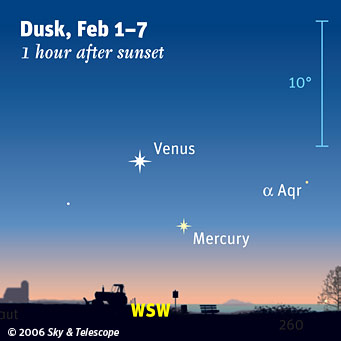
Inner Planets in the Evening
Venus and Mercury shine in the west after sunset. The pair will be closest on Sunday evening.
Get Hooked on the Ringed Planet
It's nearly full Moon, so you might need an excuse to go outside and brave the frigid weather. Here's a great one: treat yourself to the majesty of Saturn. Right now the planetary gem is shining in Leo at magnitude 0.0, and it is currently the brightest it will be for many years to come.
Amateur Astronomer Wins Pros' Accolades
The American Astronomical Society has awarded its first Chambliss Amateur Achievement Medal to Colorado asteroid enthusiast Brian D. Warner.
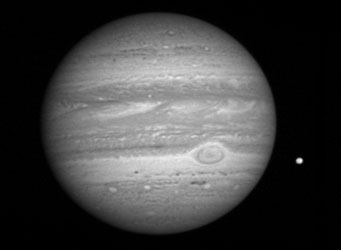
Pluto-bound Craft Nears Jupiter
With 1 year down and 8 to go until it reaches Pluto, NASA's New Horizons spacecraft is preparing for a flyby of Jupiter and crucial tests of its instruments. That flyby will occur 1.4 million miles from the giant planet, far enough away to avoid a strong dose of the lethal charged particles trapped in its magnetosphere but close enough to study the planet and its moons in detail.
Friday's Stellar Vanishing Act
This coming Friday morning you'll need only binoculars, a clear sky, and the right location to witness the best asteroid occultation visible in the continental US during the last quarter century.
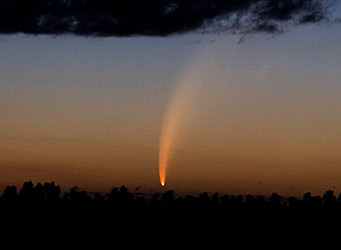
More of Your Comet Photos
Although the Comet McNaught show is over for those of us in the Northern Hemisphere, folks below the equator are enjoying quite a treat. Check out the more than 100 pictures you've sent to our Photo Gallery thus far. As all the reports have suggested, this is indeed one of the greatest comets of the past few decades.
The Milky Way's Hungry Monster
The Milky Way has a monster black hole lurking in its core, but it's on a starvation diet. The black hole, known as Sagittarius A*, weighs in at about 4 million solar masses. But despite the beast's overwhelming gravitational pull, recent studies show that it consumes only a pathetic fraction of Earth's mass in a typical year. For some unknown reason, very little food is falling into the black hole, so it remains calm and quiet — radiating very little energy. But fortunately for the monster, every now and then it enjoys a snack.
Eclipses in 2007
Two total lunar eclipses are visible from parts of North America in 2007. But if you're looking for a total solar eclipse, you'll need to wait till August 2008 — and travel to Central Asia.
Astronomer Don Osterbrock Dead at 82
One of the leading American astronomers and astronomical historians of the 20th century died on January 11, 2007.
AAS Supernova Roundup
At the American Astronomical Society conference in Seattle on Tuesday, independent teams of astronomers reported new results about supernovae, the cataclysmic explosions of stars. These results clarify one mystery, while challenging fundamental assumptions about what types of stars can go kaboom.

Extra Narrowband Hydrogen-Alpha Imaging Filter
Orion Telescopes & Binoculars' new Extra Narrowband Hydrogen-Alpha Imaging Filter lets you shoot high-contrast views of emission nebulae even from light-polluted locations.

Lightweight Observatory
Smart Astronomy has introduced the Clear-View Portable Observatory Tent, a lightweight and effective means for you to observe in comfort, free from wind and annoying stray light.
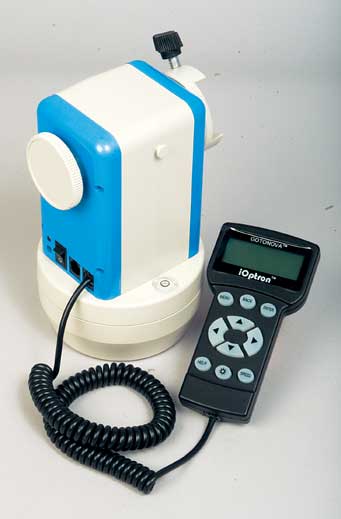
Economical "Go To"
With the overwhelming popularity of Go To telescopes, it's surprising that a product like the Cube from iOptron hasn't come along before now.
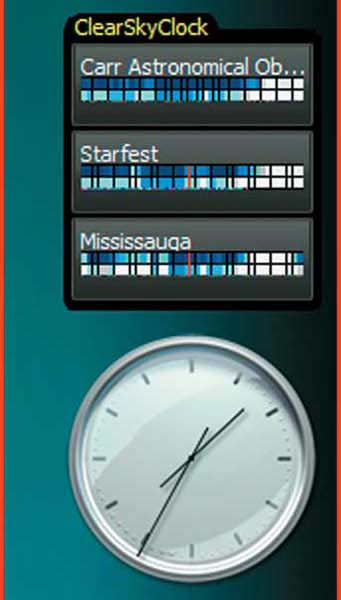
Clear-Sky Gadget
If you live in North America and have a PC running Windows Vista, you can have Attilla Danko's Clear Sky Clock (CSC) on your desktop 24 hours a day.
