 SUNSET:


Lightweight Observatory
Smart Astronomy has introduced the Clear-View Portable Observatory Tent, a lightweight and effective means for you to observe in comfort, free from wind and annoying stray light.
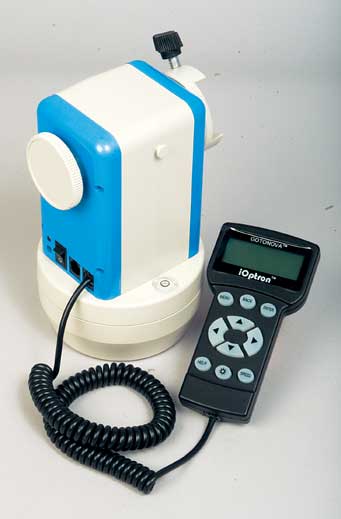
Economical "Go To"
With the overwhelming popularity of Go To telescopes, it's surprising that a product like the Cube from iOptron hasn't come along before now.
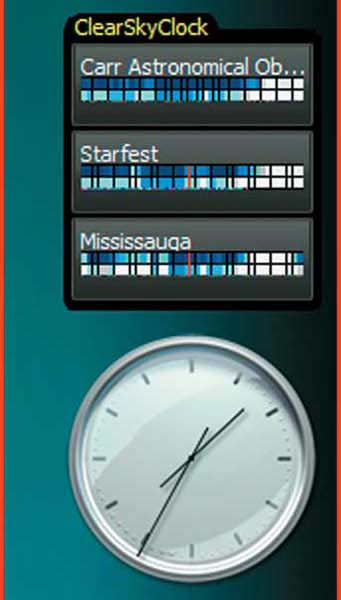
Clear-Sky Gadget
If you live in North America and have a PC running Windows Vista, you can have Attilla Danko's Clear Sky Clock (CSC) on your desktop 24 hours a day.
The First Triple Quasar
In an announcement made on Monday at the American Astronomical Society conference in Seattle, astronomers confirmed that quasars can come in threes.

News from the AAS
About 3,000 scientists from around the world gathered Sunday in Seattle, Washington, for the 209th meeting of the American Astronomical Society. Hundreds of discoveries were announced on the conference’s first day. Here are few of the highlights.
Meteor Showers in 2007
The coming year promises to be a good one for observing showers of shooting stars.
Tour January's Sky by Ear
January nights may be cold, but they boast a spectacular array of constellations. Our podcast will guide you through this month's sky with no need to fuss with paper or red flashlights.

A New Foundation for the AAVSO
The American Association of Variable Star Observers is moving into Sky & Telescope's old headquarters at 49 Bay State Road, Cambridge, Massachusetts.
The Year in Astronomy 2006
Remember when the solar system had nine planets? When the Hubble Space Telescope was doomed? And when Jupiter only had one red spot?
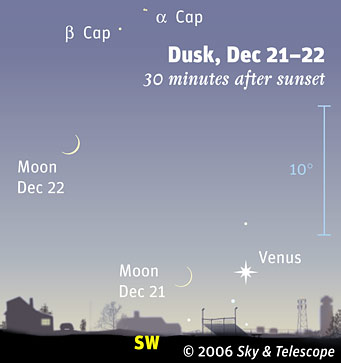
Celestial Omens
Go out at dusk to see Venus and the crescent Moon pair up. It is always a sight to behold when the brightest objects in the evening sky get together.

Life with a Red Dwarf
The commonest stars in the universe aren't very Sun-like — but they could still have life-bearing planets. However, those worlds aren't like anything you've ever seen. Imagine a home world where half of the planet basks in eternal day, the other cloaked in eternal night.
An Ancient Building Block of Life
Astronomers have long assumed that carbon-based molecules — essential for life as we know it — were among the building blocks of our solar system. Now they have the evidence to back their claims. The smoking gun came from measurements of the famed Tagish Lake meteorite.
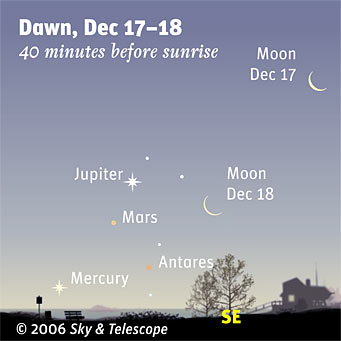
A Reason to Rise
Most of us consider weekends a time for sleeping in, but skywatchers who get up before the Sun are presently in for a treat. A trio of planets will dance with the bright star Antares, and on the mornings of the 17th and 18th there will be a guest appearance by the waning crescent Moon. The performance is free, but clear skies and an unobstructed southeastern horizon are required.
Aurora Watch!
Talk about a red-letter night for astronomy. Not only are Geminid meteors still raining down from the skies, there is a major aurora alert in effect for Thursday and Friday. No telescope needed. Just get outside and look up.

Night Sky Magazine to Cease Publication
Sky Publishing has decided to stop producing Night Sky, its bimonthly magazine for beginning amateur astronomers. The March/April 2007 issue will be the last.
Best Meteor Shower of 2006
With only minor interference from the Moon, the Geminids should put on a great display late Wednesday night and Thursday morning. What's more, a major solar flare just erupted, providing a strong chance for a tremendous northern lights show on Thursday or Friday.

Flowing Mud on Today's Mars?
Newly released images from Mars Global Surveyor strongly suggest that liquid water could be flowing across the surface of Mars right now.
Meade Steps into the Sunshine
Telescope giant Meade Instruments will acquire Coronado Technology Group, the leading manufacturer of hydrogen-alpha filters and telescopes for solar observing.

Long Island Gets a Big Scope
A nonprofit group has purchased a research-grade telescope for a planned public observatory in a dark-sky site.
Tour August's Evening Sky in 2006
Download this MP3 file to your iPod or other handheld device, and you'll be guided to Jupiter, the constellation Scorpius, the Milky Way, and more! You'll also get tips on when and how to watch the Perseid meteor shower. (5.5MB file; hosted by Kelly Beatty, editor of Night Sky magazine.)
