 SUNSET:

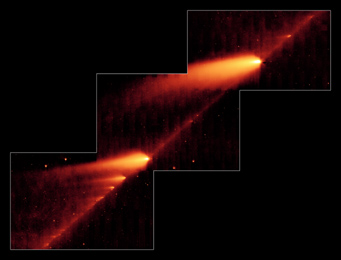
Cometary Puzzles
At this week's Division for Planetary Sciences meeting in Pasadena, California, astronomers spent two days presenting research about the elusive question of comet composition. One might assume that the makeup of dirty snowballs should be consistent. However, the consensus in the halls of the Pasadena Convention Center this week is that they can differ wildly from each other.

Why Doesn't Venus Have a Moon?
Back when Earth was an infant, it was pummeled by solar system debris. One blow nearly destroyed it; the debris from that collision coalesced to form the Moon. But how did our neighbor in space, Venus, dodge the same fate? New studies say it didn't.
Hubble Captures Evidence of Planets Far Away
By peering some 20,000 light-years into the star-swarms of the Milky Way's central bulge, astronomers using the Hubble Space Telescope have turned up 16 possible new planets crossing the faces of their stars, two of which have been confirmed.
How I Found My New Comet
In an exclusive story for SkyandTelescope.com, prolific comet hunter David Levy explains how he stumbled across find number 22 while observing near Saturn.

England's Autumn Sky Camp
For those who were fortunate enough to attend Britian's Autumn Equinox Sky Camp, they were treated to nine days of astronomical camaraderie along with a few nights of near-perfect observing conditions.
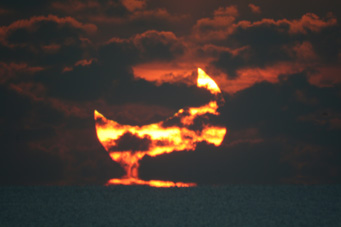
A South American Ring Eclipse
Guyana, Surinam, and French Guiana were the places to be to see last Friday's annular eclipse of the Sun. These small tropical countries on the northern coast of South America were the only solid ground touched by the path of annularity at sunrise that day; the rest of its narrow, 13,800-kilometer-long track traversed the open waters of the South Atlantic.
Beautiful Universe Reader's Choice Award
Cast your ballot now for the Beautiful Universe 2007 Edition Reader's Choice Award. Our judges have culled the very best images from the hundreds of reader submissions. Have a look at the amazing shots in each of the nine categories and choose your favorites!

A Crescent Moon and Friends
The crescent Moon all by itself is a gorgeous sight when it hangs low above the horizon amid twilight. The scene improves when it's paired with a second bright object. During the next several evenings the Moon will move southward and upward as it waxes toward first-quarter phase on September 30th.

Mercury-Moon Meeting
Shortly after sunset on Sunday the 24th, you may be able to catch the ever-elusive Mercury in an unusual lineup with Spica and a thin crescent Moon. This one will be a challenge.
An Atlantic Solar Eclipse
On Friday, September 22nd, the Sun will rise as a shining ring of light for lucky skywatchers in South America and Africa.
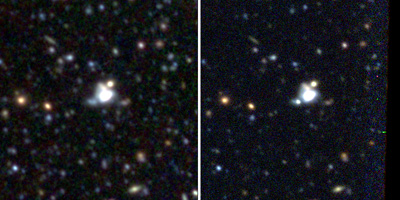
Astronomy's "Impossible" Supernova?
For decades, one of the canonical doctrines in astronomy is that a white dwarf cannot exceed 1.44 solar masses. But now astronomers have found a Type Ia supernova that seems to break the rules.

An Early-Morning Close Encounter
Here's a fun challenge for those who wish to get up with the Sun. About 40 minutes or so before sunrise, head outside and look to the east. As dawn's light grows bright, the hairline crescent Moon has a close conjunction with Venus just above the eastern horizon.
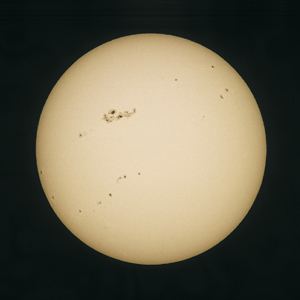
Solar Variations Not to Blame for Global Warming
Researchers in the US, Switzerland, and Germany have concluded that changes in the Sun's brightness over the past thousand years have had only a minor effect on Earth's climate, according to a paper published in the September 14th Nature.
All Hail Eris and Dysnomia
The bigger-than-Pluto object 2003 UB313 (previously known as Xena) finally has a name. This Kuiper Belt object, which ignited the heated planet-definition debate, will be known as Eris — named for the Greek goddess of strife and discord.

New AAS Award for Backyard Research
A new award from the American Astronomical Society recognizes the contribution of backyard stargazers to advancing the science of astronomy.
Pluto Gets an Asteroid Number
Without fanfare, the September 7th batch of circulars from the Minor Planet Center assigns number 134340 to Pluto.
SMART 1's Dramatic Finale
Right on cue, a European spacecraft slammed into the lunar surface on September 3rd and created a flash on impact bright enough to be seen on Earth.
Earth Bites Moon
On the night of September 7-8, a partial lunar eclipse will be visible in Europe, Africa, Asia, and Australia. On the same night, observers on the west coast of the Americas will see a double shadow transit on Jupiter. Head outdoors and see it for yourself.
Shadow Transit on Uranus
For the first time in recorded history astronomers witnessed the shadow of one of Uranus's tiny moons travel across the distant planet's cloud tops.
The Fight for Pluto Rages On
A small but growing group of scientists has made the first formal attack against the International Astronomical Union resolution that downsized the solar system and made Pluto a "dwarf planet." On Thursday two heavy hitters in the planetary science community released a scathing petition signed by hundreds of astronomers.
