 SUNSET:


Making the Case for "Planet Nine"
Does a massive, extremely distant planet orbit the Sun? A new analysis of distant solar-system orbits argues that it should exist.

Martian Gullies: Triggered by Dry Ice?
Are enigmatic gullies seen on many steep Martian slopes caused by liquid water or instead by episodic coatings of frozen carbon dioxide?
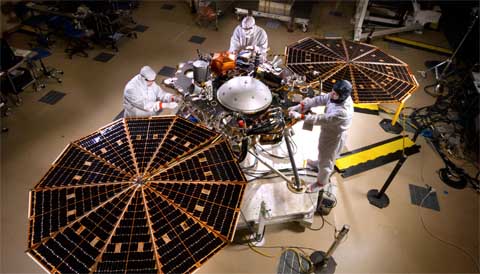
NASA Nixes Launch of InSight in March 2016
A mechanical problem in the spacecraft's seismometer can't be fixed before the planned launch date, so NASA managers have postponed the mission until 2018.

NASA's Plans for Putting Humans on Mars
Scientists and engineers gathered together to figure out what would make a good Martian landing site and what hurdles they’ll have to overcome for a 2035 launch.

New Star and Exoplanet Names OK'd by IAU
Following a wildly popular contest, the International Astronomical Union has named 14 stars and 31 planets that orbit them.
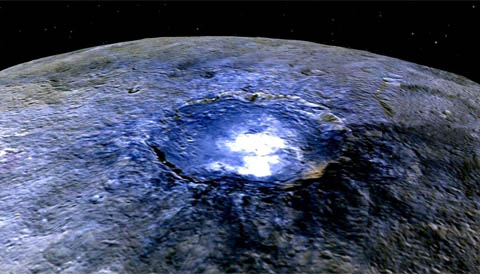
Bright Spots on Ceres: Mystery Solved?
Results from NASA's Dawn spacecraft hint that the stark brightenings in and near scores of craters on Ceres might result from salty brines seeping onto the surface.

Japan’s Akatsuki Reaches Venus . . . At Last
Engineers executed an innovative contingency plan to save the Akatsuki spacecraft and place it in orbit around our sister planet.

Will Phobos Create a Ring Around Mars?
Dynamicists predict that the larger of Mars's two moons will shatter to create a ring, slam into the planet — or both — in 20 to 40 million years.

V774104: Solar System's Most Distant Object
An ultra-deep survey has turned up a sizable object situated nearly 10 billion miles from the Sun — more distant than any known solar-system object.

Where and When Will Rosetta Crash?
As ESA's comet orbiter enters its final year of operations, mission managers are deciding its fate.

Pluto's Cold Atmosphere and "Volcanoes"
Four months after New Horizons' historic flyby, mission scientists have been amazed by unexpected discoveries — and by how some preconceptions about Pluto were flat-out wrong.

Mars Losing Gas to Solar Wind
NASA’s Mars orbiter MAVEN has painted a detailed picture of how the solar wind robs the Red Planet of its atmosphere.

Mystery Object to Reenter Earth's Atmosphere
WT1190F will burn up over the Indian Ocean on November 13th, giving researchers an unprecedented opportunity to follow its path — and figure out where it came from.
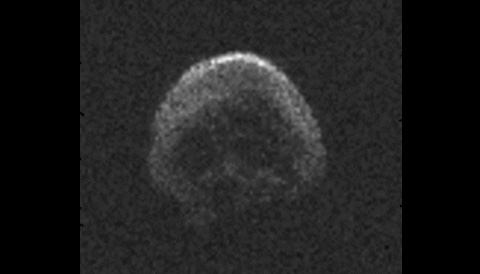
2015 TB145 — Rogue Asteroid or Dead Comet?
Astronomers can't decide whether the sizable object known as 2015 TB145, which is cruising past Earth today, is a renegade asteroid or a dead comet.

Cassini Flies Through Enceladus's Plume
On October 28th, the Cassini spacecraft took its deepest dive through the water plume spewing from the south pole of Saturn’s moon Enceladus. It passed only 30 miles (50 kilometers) above the icy surface.

"Top 10" Surprises from the Pluto Flyby
New Horizons' principal investigator describes the most amazing discoveries made when NASA's New Horizons spacecraft flew past Pluto last July.

Close-in Asteroid Offers Halloween Treat
The recently discovered asteroid 2015 TB145 won't come especially close to Earth on October 31st, but it's big enough to be seen in medium-size backyard telescopes.

Pluto-Charon Results Highlighted in Science
Forget the high-octane press releases. NASA's New Horizons team has detailed the mission's early results in today's issue of Science.

Hubble's Stunning New Jupiter Images You Have to See
A Hubble legacy program has returned high-res pictures of Jupiter, revealing changes to the Great Red Spot and mysterious new wisps in the North Equatorial Band.

