 SUNSET:

Ski Luna!
Geologists once believed the Moon was utterly dry. But just-announced results argue that abundant water ice lies stashed inside lunar craters near the north pole.
Halfway to Pluto
Zipping outward at more than 36,000 miles per hour, NASA's New Horizons spacecraft has reached a point where it's closer to its target, Pluto, than it is to the Sun. Only 1½ billion miles to go!
NASA's New Eye on the Sun
Thursday's launch of the Solar Dynamics Observatory gives astronomers the power to reveal the goings-on deep inside our star.
New Plan for NASA
The Obama administration abandons NASA's Constellation Moon program, but sets its sights farther afield.
Spirit Morphs into a Martian Lander
NASA managers have decided to halt attempts to free a Martian rover that's been stuck in sand for 10 months and to concentrate instead on "stationary science" that doesn't require mobility.

WISE Sees First Light
Scientists unveil the first image from the Wide-field Infrared Survey Explorer satellite, which will map the sky in depth and detail at new wavelengths.
Kepler's First Exoplanet Results
NASA scientists announced this morning that the Kepler planet-hunting probe is working great, has produced a slew of results, and is working at high enough precision that it should be able to determine the abundance, or rarity, of Earth-size worlds galaxy-wide.
Saturn's Prometheus: Just Plain Weird!
A remarkable new close-up of a "ring shepherd" reveals muted surface features that make it look more like a giant gray potato than a planetary satellite.
WISE: A Very Cool Space Telescope
Early this morning a Delta rocket soared into the predawn darkness over California. It carried aloft a space observatory designed to map hundreds of millions of hidden cosmic treasures at infrared wavelengths.

"Free Spirit" Effort Hits a Snag
The bad news is that NASA engineers aren't having much luck freeing one of their Mars rovers from a quagmire of soft sand. But the good news is that it's gotten stuck in a remarkable deposit where steam and molten rock once mingled.
Cassini Visits a Science-Fiction World
NASA's Cassini probe grabbed three-dimensional views of a landscape of geysers, as the craft sped above an evening twilight zone on Saturn's moon Enceladus.
Rosetta Bids Earth Adieu
A European comet-chaser has made its third and final flyby of its home planet, taking a few snapshots when it was nearby.
Bird's-Eye View of Tranquility Base
Did Armstrong and Aldrin really walk the Moon? An incredible new image from NASA's Lunar Reconnaissance Orbiter should erase any naysayer's lingering doubt.
LCROSS Impact Kicked up Lunar Water
It took more than a month of fevered analysis, but NASA scientists are at last convinced that October 9th's crash by the LCROSS spacecraft on a shadowed lunar plain vaporized at least 100 kg of water.
Phoenix Amid the Winter Snow
An orbiting camera has spotted NASA's Phoenix lander amid deepening dry-ice snow in the Martian arctic. Hardly anyone expects the craft to have survived the long, dark, bitterly cold winter — but engineers will attempt to reestablish contact anyway in a few weeks.
Kepler's Twitchy Detectors
NASA's new planet-hunting spacecraft, launched seven months ago, has a few noisy detectors that make the stars under study appear to flicker. It's a problem the mission team knew about — and decided not to repair before sending the craft irretrievably into space.
Strange Brew at LCROSS's Crash Site
NASA scientists haven't said much since a spacecraft and its carrier rocket slammed into a lunar crater on October 9th. One reason might be that they can't believe what they're finding there.
Mercury Throws Geologists a Curve
When NASA's Messenger spacecraft zipped past the innermost planet for a third and final flyby on September 29th, a glitch caused half of the planned observations to be lost. Scientists are thrilled to have the other half — but they're not entirely sure what to make of them.
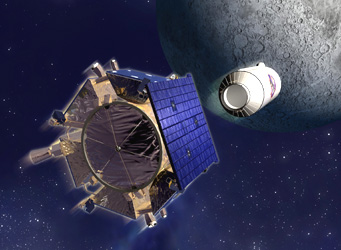
The LCROSS Impact, Continued
We've added updates our story on the Moon probe that NASA hoped would raise a big dust-and-vapor splash. The debris plume has indeed been seen. But how much information can be extracted from it?
LCROSS Readies to Shoot the Moon
Early Friday morning, two spacecraft will slam into a permanently shadowed crater near the Moon's south pole in the hope of finding water there.
