 SUNSET:

Future Shock From Gliese 710
Is our solar system's Oort Cloud in danger of being stirred up by a passing star? A fresh analysis of Hipparcos observations argue that the answer is most likely "yes" — but not for another 1.4 million years.
Zodiacal Light's Mystery Solved
Eerie and elusive, the zodiacal light is created from sunlight glinting off countless dust particles in the inner solar system. At last, astronomers have figured out where all that grit comes from.
Ski Luna!
Geologists once believed the Moon was utterly dry. But just-announced results argue that abundant water ice lies stashed inside lunar craters near the north pole.
The New Face of Pluto
Planetary scientists scratching their heads over the dramatic face-lift that this distant little world underwent sometime between 1994 and 2002.
A "Whodunit" in the Asteroid Belt
Astronomers are still trying to piece together the story of an object that's looking more and more like the aftermath of the collision between two small asteroids.
New Report Spotlights Impact Hazards
A meaty review of the impact hazard facing Earth has just been released by the U.S. National Research Council. The bottom line? If Congress and NASA are serious about finding all the truly threatening asteroids in our planet's vicinity, they'd better fund the search properly.
A Strange "Comet" Among the Asteroids
It looks a comet, or at least parts of one, in high-power telescopic images. But in the two weeks since the discovery of P/2010 A2, astronomers are still wondering what's going on with this unusual object and its asteroid sidekick some 95 million miles from Earth.
Saturn's Prometheus: Just Plain Weird!
A remarkable new close-up of a "ring shepherd" reveals muted surface features that make it look more like a giant gray potato than a planetary satellite.

An Accidental Asteroid Occultation?
It's probably the smallest Kuiper Belt object ever seen, but the evidence is indirect, and not all are persuaded.
A Glint of Sunlight from Titan
With the Sun climbing higher in the northern hemispheres of Saturn and its retinue of moons, the Cassini spacecraft captured a specular reflection off the surface of Titan — and nailed the case for lakes of liquid ethane.
Has Iapetus Finally Been Solved?
Saturn's bicolored moon, snowy white on one side and coal-black on the other, has puzzled astronomers for three centuries. Planetologists now think they have it all figured out.
Cassini Visits a Science-Fiction World
NASA's Cassini probe grabbed three-dimensional views of a landscape of geysers, as the craft sped above an evening twilight zone on Saturn's moon Enceladus.
LCROSS Impact Kicked up Lunar Water
It took more than a month of fevered analysis, but NASA scientists are at last convinced that October 9th's crash by the LCROSS spacecraft on a shadowed lunar plain vaporized at least 100 kg of water.
Mercury Throws Geologists a Curve
When NASA's Messenger spacecraft zipped past the innermost planet for a third and final flyby on September 29th, a glitch caused half of the planned observations to be lost. Scientists are thrilled to have the other half — but they're not entirely sure what to make of them.
Strange Brew at LCROSS's Crash Site
NASA scientists haven't said much since a spacecraft and its carrier rocket slammed into a lunar crater on October 9th. One reason might be that they can't believe what they're finding there.
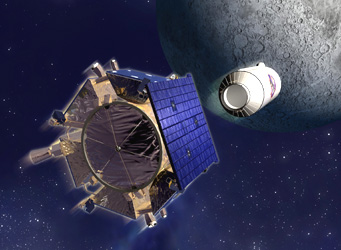
The LCROSS Impact, Continued
We've added updates our story on the Moon probe that NASA hoped would raise a big dust-and-vapor splash. The debris plume has indeed been seen. But how much information can be extracted from it?
Less Ado About Apophis
Now you can make plans for April 13, 2036, without worrying about a giant space rock crashing into Earth and ruining your day.
Saturn's New King of the Rings
Faint but real, a newly found ring encircles Saturn out to distances of 11 million miles.
A Fall to Earth, One Year Later
Planetary astronomers had less than a day's notice before asteroid 2008 TC3 crashed into Earth one year ago. But they've made the most of the strange black fragments of it that fell to the ground that day.
LCROSS Readies to Shoot the Moon
Early Friday morning, two spacecraft will slam into a permanently shadowed crater near the Moon's south pole in the hope of finding water there.
