 SUNSET:


Mars Rover Unearths Ancient Hot Springs
The Mars rover Spirit uncovers evidence for hydrothermal activity on the Red Planet and a possible cache for microbial fossils.
Puny Star's Big Flare Wows Astronomers
While a NASA satellite looked on, last month a red dwarf in Lacerta erupted with a titanic — and unexpected — burst of energy.
Supernova Caught at its Very Start
By an unbelievable stroke of luck, X-ray astronomers catch the first minutes of a supernova explosion. You wouldn't have wanted to be there.
Comet Boattini Brightens
During May and June 2008, this visitor may be dimly visible without a telescope — but only if you live in the Southern Hemisphere.
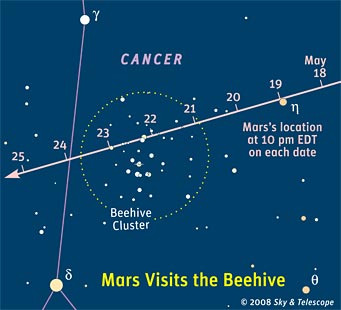
Mars Meets the Beehive
The Red Planet travels through one of the biggest and brightest star clusters in the sky from May 21st to the 24th. As a warm-up, stargazers watched Mars pass a hair's-breadth north of 5th-magnitude Eta Cancri on the evening of May 19th in easternmost America and the morning of the 20th in western Europe.
Comet Boattini: Barely Visible Now, Bright in July?
Comet C/2007 W1 (Boattini) has reached 5th magnitude as of early June. It's now visible only from the Southern Hemisphere. When it reappears for northerners in July, will it be naked-eye?
Jupiter Goes Moonless
For 18 minutes on the night of May 21-22, the King of Planets will be missing his entire court — as all four Galilean satellites disappear from view.
Find a Missing Mars Lander!
Ever since it crash-landed in 1999, NASA's Mars Polar Lander has been playing "hide and seek" with scientists trying to locate its remains. Now they want you to try.
The Milky Way's Most Recent Supernova
Hidden behind interstellar clouds is a blast wave from a star that blew up as recently as 1850.
Microsoft Launches Astronomy Software
Software giant Microsoft wants to show you the universe with its WorldWide Telescope.
"The Antennae" Fall Into Line
A spectacular pair of colliding galaxies starts to make better sense.
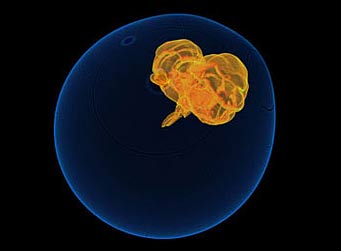
How Type-Ia Supernovae Work: The Movie
You thought an exploding star would be simple? Hah.
Hubble Servicing Delayed
NASA's upcoming service call on the Hubble Space Telescope won't happen till late September or early October.
A Rare Chance To See "Opposing Crescent" Moons
Here's a special challenge for North American skywatchers on Sunday morning and Monday evening. But this one is tough. To prepare for glimpsing Sunday morning's crescent Moon, watch the sunrise on Saturday morning.
Tour May's Sky — By Ear and Eye!
What better way to enjoy May's evening sky sights than to let Sky & Telescope take you on a guided tour?

Telescopes: Guides & Recommendations
Portaball Reborn
Mag 1 Instruments, maker of the Portaball Telescope, is alive and well under a new owner.
Using a Telescope Mount to Watch Baseball
An interesting use for a computerized mount.
Robert Naeye Appointed S&T's New Editor in Chief
New Track Media, Sky & Telescope's parent company, announced today that Bob Naeye will succeed Rick Fienberg as the magazine's editor in chief.

Carter Worth Roberts, 1946–2008
A pillar of amateur astronomy in the western US has died at the age of 62.
